Friday, 10 October 2014

Ukwa Breadfruit

African breadfruit (ukwa) is definitely one of the popular Igbo foods, so it is well worth a good place on a list of foods eaten by the people of Igbo (a very popular Nigerian tribe).
People keep wondering ‘what is African breadfruit?’ and how to prepare it the exact way an Igbo person would like it.
The majority of the questions I get via my contact form are from ladies that are married to a Nigerian man, What to serve a Yoruba man for dinner? What to serve an igbo man for for breakfast and stuff like that.
That was the main reason I started an entirely new series on foods eaten by different Nigerian tribes and here we are dealing with African breadfruit (ukwa) as one of the popular Igbo foods.
Ukwa (African Breadfruit
I will try to explain in detail how this recipe was prepared in my own very kitchen and then I would talk briefly on another recipe of Ukwa that I know about.

The Two Ukwa Recipes

Ukwa is a very popular food in the eastern part of Nigeria, the people of Igbo are very familiar with the two recipes that I would be talking about below.
Ukwa could be cooked with potash and just eaten like that or it could also be separated from the water for just the seeds to be mashed with some ingredients and thereafter served with the extract (water).
I refer to the juice after cooking as the extract, I think you will learn more about this by watching the video for African breadfruit. (Below), the entire steps outlined here was demonstrated in detail.
Below are the ingredients for preparing Ukwa (African Breadfruit), what you have below would serve about three people, you can increase or decrease depending on the number of persons you are looking to serve and of course stomach sizes .
The ingredients
4 cups of ukwa
Potash (akanwu) a spoon full
Fresh pepper (about 5)
Ogiri (optional) (a local ingredient)
Maggi (half cube)
Salt to taste
Red oil (5 to 10 cl)
2 cups of maize (optional)
How To Prepare Ukwa
Cook the corn till it is very soft for consumption
Wash the ukwa, It is necessary to wash severally in a bowl with lots of clean water, I also use a plastic sieve just to be sure that all hidden tiny stones are sorted out,
Put in a cooking pot and cook to boiling point before adding the potash, normally I dissolve the potash in water to filter out the residue, and then add the filtrate. You will also learn more about this from the video below.
It is needful to note that Ukwa does not ever get soft (done) without the use of the catalyst (potash), I tried this in secondary school and we cooked for more than four hours before we realized that something was missing. There is another ingredient that serves the same purpose as potash, it is in the form of ash gotten from the burning of palm fronds, it is locally called ngu and the people of Igbo prefer it above Akanwu (potash)
If you want to make Ukwa with ngu apply the same method as though you are using potash, dissolve in a cup of water allow for a minute or two then use the filtrate.
Cook till the ukwa is soft for consumption and you can serve. This is one of the two ways to eat African breadfruit in Nigerian, some people like to add a pinch of salt while some part of Igbos don’t use salt for this particular recipe.
The second recipe continues where the one above stopped.
Once the Ukwa Seeds are soft for consumption Separate the seeds from the water, (that is to sieve out the soft seeds from the water) most people prefer to eat just like that or make it the way it appears above.
Pound the pepper with mortar and pestle (remember this is real local but delicious meal), add about 5cl of red oil, a half cube of maggi, one ball of ogiri and stir (use a garri turner, a spoon-like wood), add the soft corn, stir then add the soft ukwa seed then turn very well with the garri turner and you will get the exact resemblance of the image above.

AFANG SOUP FROM CROSS RIVER.

Afang soup is fast climbing the top of the list of popular Nigerian soup. If you are interested in exploring Nigerian foods, this delicious soup would definitely soar your interest.
This delicious soup is native to the Efiks, the major occupant of (Cross River & Akwa Ibom State). It really doesn’t matter your language, background or ethnic group, you can go ahead and try different foods from different Nigerian cultures and ethnicity.
Over the last few months I have been focused on Efik delicacies, afang sits right on top of the list and today we are going to learn how to make afang soup as well as other delicious Efik/Calabar foods.
I think After Igbo, Hausa and Yoruba; Efik is another popular group in Nigeria; they have delicious foods that have left the rest of us salivating. Apart from the afang soup, they also have Edikang-Ikong, atama, nsala and a few other delicious soups.
Afang is made with afang leaves (ukazi) and water leaves, this two different leaves combines seamlessly to make a delicious looking afang soup. The Ukazi leaf is usually sliced and then ground with either a kitchen blender or hand-grinding machine while the water leaf is just sliced with a kitchen knife.
I just like this soup because it is made with just vegetables; and I love vegetables! – They are nutritious, medicinal and contain fiber that helps the body cells to function properly. Don’t let your focus be on just Foods alone, also make sure they are also healthy for consumption.
Afang soup Ingredients
So let’s make a delicious pot of afang soup, the list of ingredients below would make enough soup that would serve about ten persons.
Most people complain that vegetable soups are not easy to prepare, usually because it takes time to pick and slice the different leaves. But once you pass that phase, the rest is EASY.
  • Sliced fresh water leaves (1kg)
  • 1/2 cup of ground crayfish
  • Ground fresh Ukazi leaves (200g)
  • 3 cubes of knorr (sweetener)
  • 1 stock fish head (medium size)
  • 2 medium sized dried or roasted fish
  • 1.5 cups of palm oil
  • 1 cup of Periwinkles (optional)
  • Snails (optional)
  • Salt and Pepper to taste (red fresh pepper)
  • 1-2KG of any meat of choice.
Assorted meat is the most suitable for afang soup but if you can’t find it in your location you can use any meat at all. I used a combination of assorted meat and pkomo.
Wash the snails with lime juice or grape juice and be sure it is rid of its slimy fluid. The periwinkle (isam) are usually cleaned by the sellers, you just need to wash.
The ground ukazi leaves act as thickener for this soup, I use fresh leaves for all my soup but if you can’t find fresh stuff in your location, go ahead and substitute with the dried alternative. You can tell from the image above that the leaves are fresh.
Just go ahead and start parboiling the meat with all the necessary ingredients. (2 cubes of knoor, half cup of sliced onions, salt and other spice of choice)
Some people wash the water leaves before slicing them while other choose to slice them before washing; I prefer the former. Wash and slice the water leaves and set aside in a plastic sieve to make sure that water is properly drained away.
Most people don’t like trace of water in their afang soup, but to achieve this you may have to really overcook the water leaves or dry them in the sun. But I kick against those practices as it will likely improve the loss of its nutritional value. So I really don’t care about the extra water. :D
Voila!
Afang Soup
Soak the dried fish with warm water, remove the center bones and wash thoroughly with just water; also wash the stock fish head with warm water. Add them to the cooking meat and cook till they are soft and the pot is almost dry. Add the palm oil, crayfish and stir all together. Add the remaining cube of knoor, ground pepper, snails and salt to taste, allow cooking for 3-5 minutes.
Add the water-leaves; allow to simmer for 3 minutes before adding the ground ukazi. Stir all together, cover the pot and allow another 2 minutes and you are done with a delicious afang soup.
Afang soup can be served with fufu, eba, pounded yam, wheat. Any nice soft drink would be a welcome addition.
There are other delicious efik soups that you may wanna give a whirl, compare Edikang-Ikong & Afang soup

Sunday, 5 October 2014

JELLOF RICE IN NIGRRIA WAY;

Nigerian Jellof Rice


Jollof rice is one of the most simple and the easy to make Nigerian food, you would want to start from here if you are new to making Nigerian foods.
Are you married to a Nigerian person and probably looking for an easy to make African Food?

Ingredients for Making Nigerian Jollof Rice 

4 cups of rice
2 kg of Chicken (I just like to use chicken but you can use any kind of meat that suits you)
1 cup of crayfish (optional, I don’t use it)
1 to 1.2 liter of Ground Fresh tomatoes (your blender is calibrated, 1000ml = 1 liter)
40 to 100 ml Ground Fresh peppers
Spices (Curry, Thyme, Delice, Nutmeg, you can spice to your taste and desire)
2 cubes of knorr of maggi
2 Bulbs of onions
20 to 30 cl vegetable or groundnut oil
salt to taste.
Parboil the chicken (or any meat of your choice) with the spices listed above. I like to use lots of them so as to end up with a very tasty fried chicken, and then prepare the main food with the meat extract (meat water) with very little or no extra spice. Add water so that more than half of the entire chicken (or meat of choice) is submerged, then add sliced 1 bulb of onions, 3 cubes of maggi or knorr, one tea spoon of salt and maybe a little of curry, thyme and (or) spice of choice.
Nigerian Jollof Rice
The good thing about Nigerian Jollof rice is that you can spice to your taste, one person might choose to make with chicken spices while another might decide to use curry and thyme or even just a seed of nutmeg and they will all end up with a delicious plate of rice.
Parboil the rice the normal way, boil about three cups of water in a pot, add the four cups of rice and allow to cook for three to four minutes. Then pour out and wash thoroughly with clean water then set aside in a bowl or plastic sieve as you will always see in my videos

Here is How to Make Nigerian jellof Rice.

You might want to pick out the parboiled tasty chicken and deep fry in vegetable/ ground nut oil, this wouldn’t take more than 10 minutes.
Then remove some of the oil if it is above fifteen to twenty centiliter, just so you don’t end up with lots of oil at the bottom of your pot. I like to commence cooking jollof rice with the same oil I used in frying the chicken, Using a fresh oil is just the same as cooking without the meat extract (meat water) which actually hold over 70 percent of the ingredient that is used in making most Nigerian foods, you will end up with a tasteless meal.
Add sliced onions to the hot oil and then the ground tomatoes/pepper after about a minute. Fry until the tomatoes looses its sour taste due to frying (about ten to fifteen minutes later), I like to divide the tomatoes after frying, then continue cooking with half and add the other half later.
This is s trick that helps reduce burning, most jollof rice end up getting burned at the bottom of the pot
So divide the tomatoes and commence cooking with one of the halves in the pot, add the meat extract (meat water), then about 1 or 2 cups of water, (you can add a little more water later), add the ground crayfish (if you are using crayfish), a cube of maggi or knorr (if the meat extract) is not a good as desired, add salt to taste.
Stir and taste the whole solution.
Spice to your taste with your desired flavors and spices, then add the rice, lower the heat and cover to cook. You can add the other half of the fried tomatoes after cooking for ten to fifteen minutes, also slice onions and spray at the top (I like to use lots of onions on Nigerian jellof rice), this has its health benefits.
Then just cook till the rice is soft for consumption, Remember that you can add water occasionally. Then you can drop the fried meat at the top and cover in the last five minutes.
You just made a very delicious Nigerian Jollof rice, you can serve with the fried meat and maybe a bottle of your favorite drink

Friday, 3 October 2014

Nigerian Drinks''''''''''''''lllllllllllll;;;;;;;;;;


Nigerian drinks include both soft drinks and all kinds of edible juice that are prepared and consumed in Nigeria. This article aims to showcase some of those drinks and explain how the ordinary person can be able to make them for personal consumption.
Apart from the popular brands like Cocoa Cola, Pepsi, laccasera, Viju milk etc. we are going to learn how to prepare some of the locally made drinks in Nigeria.
I find most of them to be very tasty and also healthy. Take the zobo drink for instance. I had a taste of this drink for the first time at Bori Camp Portharcourt, those days in secondary school; I visited a friend who happened to be from Yoruba, the best makers of the Nigerian zobo drink.
That was the first time I was offered a glass of zobo, at first I objected but my colleague compelled me to take a sip and that was it… I was sold!!!
By reading this article you will learn how to make some of the popular Nigerian drinks, all of them would be soft drinks that could be consumed by both adults and children alike. I got a message from a member of the Kitchen who wanted to make the chapman Nigerian drink for the kids.
So we are going to be making Chapman, the zobo drink and also a particular kind of fruit juice. We have lots of fruits in Nigeria but the average Nigerian person is yet to learn how to get the best from these fruits.
So most time we just allow them to waste away when we have them in large quantity, the best thing would have been to make fruit juice out of them.
Fruits can be eaten fresh or turned into a very tasty juice. We have pineapple juice as one of the Nigerian drinks. There are other popular drinks in Nigeria like orange juice and a blend of different fruits, some of these fruit juice are very healthy and helps to fight heart diseases.
Over the past few months I have been writing about healthy Nigerian foods and why it is necessary to eat healthy foods in order to live a longer and healthy life.
I just finished a free eBook that would teach you how to make healthy foods. It is a must-have for every Nigerian, that is why it is free. The information contained within is considered priceless, no kidding. Learn more about The Science of Healthy Nigerian Foods

Wednesday, 1 October 2014

RIVERS NATIVE SOUP IN NIGERIA............................

River state native soup is one of my favorite of all Nigerian soup, it happens to be my favorite native soup. You can follow either my written instruction or the embedded video at the bottom of the page, I make videos for the majority of my recipes on this site.
I grew up in River state Nigeria, did both my primary and secondary school in a very popular part of the state, during this time, I tasted almost every indigenous food and also learned to make quite a few of them. The good thing is that they share similar recipes with the Igbo tribe of Nigeria.
So if you are dating an Ikwerre guy or married to a man from River State Nigeria you can go ahead and serve him some of our Igbo Recipes on this page, I learned that majority of my visitors are white girls\women that are either dating or married to a Nigerian person.
Let’s get back to the topic of the day, River state native soup.
Frankly, I can’t give a detailed account of the origin of this soup but what I do know is that it is very popular in River state and it is served in major restaurants and eateries. It was very delicious the first day I tasted it, I remember that evening vividly in a small restaurant just beside where we lived in Diobu Port-Harcourt.
There I sat with the other girls from my class and decided to do the unthinkable – ordering eba instead of the usual simple foods that women like to be seen with. I ordered eba/native soup and the gig thought I had gone crazy. That happened to be one of the best I had in a River state restaurant before I finally moved to Lagos state.
For some reason I just like to try new recipes once they appealed to me, I like to ask questions and try them out in my own kitchen, that is perhaps the reason I have learned to make virtually all the Foods Eaten In Nigeria.

How To Make River State Native Soup

Below are the ingredients for making the popular native soup in River state Nigeria, like I always assert; the ingredient would serve up to ten people, you can increase or decrease the quantity of each ingredient depending on the number of persons you are looking to serve.
2kg of goat meat
10 pieces of stock fish ear (nti okporoko)
2 to 3 cups of sliced uziza leaves
2 medium size dry fish
1 cup of (ofor or achi) as the thickener
15cl of palm oil
2 cubes of maggi crayfish
2 cups of periwinkles
1 cup of crayfish
1 Teaspoon of uziza seeds
Salt and pepper to taste.

How to Prepare Nigerian Native soup

STEP 1
I like to start by parboiling the goat meat or any other with all the necessary ingredients, most cooks forget that parboiling the meat and obtaining the juice (water left after parboiling) is an important part of the whole cooking process.
I like to parboil the meat with just 2 cubes of maggi, 1 bulb of onions, salt and maybe a sachet of onga classic (a very popular Nigerian spice for soup). Goat meat is easy to cook, takes about ten to fifteen minutes before you commence with the rest of the cooking.
Step 2
Use this time to prepare the other ingredients; wash and slice the uziza leaves.
Soak the stock fish and dry fish with boiled water and wash thoroughly to remove sand and center bone. Grind the crayfish and fresh pepper also, you can grind together or grind separately. Also grind the uziza seeds and set aside on different plates.
Step 3
Add the washed dry fish/stock fish in the boiling meat on fire, after about 15 to twenty minutes of cooking just the meat, add about two cups of water, palm oil and the ground crayfish. This step was visually demonstrated in the video below, so if you like watching better than reading you can scroll down to see the video.
Allow the soup to cook for another ten minutes before adding salt, also taste for salt and maggi. Maggi is a naturally made sweetener used in making almost all the {foods eaten in Nigeria} you can refer to our ingredients catalogue for an in-depth understanding of all the ingredients used in making Nigerian foods
Step 4
Add the ground ofor or achi, use a cooking spoon to stir randomly while doing this, allow to cook for three minutes before adding the periwinkles and sliced uziza leaves which is likely the last ingredient while making River state native soup.
Allow to cook for another five minutes and you just made Nigerian’s most popular native soup.
Here is the video as promised,

Subscribe To Improve Your Cooking!

Monday, 29 September 2014

EFO RIRO (Yoruba soup)


Efo Riro is a very popular Yoruba soup in Nigeria, it is in fact one of my favorite Nigerian soups because of its healthy benefits. The name ‘efo’ means vegetables, hence it is a Yoruba rich vegetable soup/stew. Believe me when I tell you that this happens to be one of the most delicious Yoruba soups that I have tasted.
It is a little bit similar to the popular edikaikong soup, the difference is the use of tomatoes and few other Yoruba local ingredients, although some people choose to avoid tomatoes for personal reason but I think it is very necessary.
Here are the ingredients for making efo riro, I think it would take a little over 1 hour for preparing the ingredients and then the actual cooking. As usual, the ingredients below can serve between 15 to 20 people, you can increase or decrease depending on your audience.
Ingredients Include: (for five to 7*3 serving)
Fresh vegetable leaves (water leaves, spinach or fluted pumpkin)
Stock fish head(medium sized)
2 TO 3kg meat (PREFERABLY GOAT MEAT OR BEEF)
Small fresh tomatoes (4 to five balls)
Fresh pepper (as you want)
Onions 1 to 2 bulbs)
Ground Crayfish (about 1 cup)
Iru (locust bean) 2 to 3 teaspoon full
Dried fish (two to three medium sizes)
Palm oil (15cl)
Snails (washed with lemon juice/alum) optional
Smoked fish (1 medium sized) (Optional)
2 knorr cubes

Preparation:

For most foods made with tomatoes I like to slice instead of grinding them, this improves the look of the food at the end of the day. Wash meat thoroughly with lots of water and salt to remove sand then be sure to also wash the snails with alum if you are making efo riro soup with snails.
I learned that some people avoid snails for either religious or personal reasons but I really think it kinda complete this recipe, it is very delicious in efo riro and also very rich in protein

How To Cook Efo Riro

If you follow the steps outlined below cautiously you will end up with a very delicious pot of obe efo riro, {obe} is the yoruba name for soup in case you are wondering.
Step 1
Place the washed meat in a large pot, add a little of water, season with salt, sliced onions, 1 knorr cube and ground pepper and boil for 20 minutes or until tender and the water is almost dried.
Add the smoked fish, stock fish, add a little water and cook for another five to fifteen minutes depending on the hardness of your stock fish, you need to know that people like them better when they are very soft.
Step 2
Remove the pot from heat. Place another pot on the burner and pour in some palm oil, about 15 to 20cl. Add the ground tomatoes to the heated oil (be sure not to allow the oil to bleach), Also add Cray fish, sliced onions to the hot oil and fry for 10 minutes stirring frequently
Step 3
Then follow with some locust bean seeds (iru), preferred seasoning and allow cooking for just a few minutes Pour in the cooked meat, smoked fish, stock fish and snail and allow boiling for five to ten minutes
Step 4
Finally add the washed vegetables to the sauce and allow to simmer for just 2 to 3 minutes. Do not over cook the vegetables or they will lose much of their nutritional value.
Serve the cooked Efo-riro soup with Eba, Pounded yam, Semolina or Amala or any other similar Nigerian Food or choice, I like this soup and fufu the way it appears below.
What you find below is a delicious plate of efo riro and well prepared fufu, I feel hungry every time I turn to this page. The image was actually borrowed from affyskitchen.com {thank you}
Yoruba Efo Riro
The video for this soup is coming! In the mean time you can go ahead and read up other articles about Yoruba foods. Efo Riro is just one of them, you can also learn how to prepare gbegiri (the popular beans soup),

AFRICAN SPECIAL SALAD...................

African Salad (Abacha)

                                                                        African salad is a delicious Nigerian meal that is native to the ndi Igbo (people of Igbo), here is all you need to know about this Nigerian Delicious Dessert and even all the ingredients used in preparing it.
This meal is very popular in the eastern part of Nigeria; it is one of the most Popular Igbo Recipe, I don’t visit this part of the country and come back without having a taste of this Nigerian delicacy.
Abacha – as the Igbos love to call it –  is one of the most popular evening desserts in the eastern villages, it serves best as kola to visitors, as a matter of fact, there are villages in the eastern part of Nigeria that only offer ugba or abacha to visitors and even visitors have come to love and desire the delicious delicacy.
The fresh Abacha (African salad is a by-product of cassava), there are a lot of processes involved with obtaining the fresh abacha that is used in preparing the African salad that we all know .
Most rural dwellers are very familiar with the whole process involved.
The first thing to do (if you live in the village or own a farm) is to obtain cassava tubers, wash thoroughly and boil along with water for twenty to thirty minutes then pill to remove the brown outer layer, and cut to tiny bits.
The sliced cassava is then soaked in water for 18 hours or more. The last thing to do would be to wash thoroughly with clean water then sun-dry and store in an airtight seal. Dried cassava chips can last more than a year if stored in an air tight dry environment.
But if you live in developed cities you probably wouldn’t need to go through this cumbersome and tiresome procedure, just buy every one of the ingredients in the market
Here are all the ingredients that are needed for preparing Abacha (African salad) whether you are within or outside Nigeria. Some of them are extremely required while few of them are optional

Ingredients for African Salads

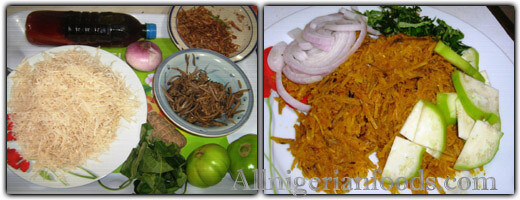
6 to 8 cups of Abacha (African Salad) {image below}
Ehu 3 seeds (optional)
1 to 2 cups Of Ugba (Ukpaka)
half cup of crayfish
1 to 2 cubes of maggi or knorr
About 10cl of palm oil
Edible powdered potash(1 teaspoon)
salt and pepper to taste.
3 to 5 garden eggs (optional)
Utazi leaves (optional)
Garden egg leaves (optional) (image in the tray below)
Meat/dry fish or stock fish.(optional)
I told you that most Nigerian foods are served with either fish or meat, Even the African Salad (Abacha) is also served with either fish, meat or even stock fish (okporoko), although there is none of that in the image below.
Here is how to prepare African salad.
African Salads in Nigeria
I like using the dried abacha (as you would find in the plate above) instead of the freshly made wet abacha the only reason is because the former give you the advantage of heating at the beginning for few minutes without being overly wet.
You can either heat or soak the dry Abacha in boiled water for about three minutes, then sieve and keep on a separate bowl.
Blend your crayfish and also slice the onions, garden egg leaves. It is advisable to dissolve the powdered potash in about 5 cl of clean water; this is a trick I employ just to easily filter out unwanted solid materials that is often embedded in potash.
Filter the dissolved potash into a mortar or pot leaving out the residue.
Add about 10cl of palm oil and stir to form a yellowish paste. This is the first part to making Abacha (African Salad), add the ground crayfish and pepper, stir, then add the ground ehu if you like.
Ugba is an important ingredient in the process of making African salad, it is considered incomplete without the present of this ingredient. Ugba is usually sold in most Nigerian markets or African shops (if you live outside Nigeria).
Add the ugba to the mixture and stir, and then add the abacha, salt. It is advisable to heat the abacha (using the method outlined above) just few second before you use so it doesn’t get cold, as most people in Nigeria like their Abacha to be a little bit warm.
Stir the whole combination and you are almost through with the preparation part.
The garden eggs, the leaves and the onions are used mostly to spice up or for decoration purposes and not added during preparation but while dishing out. They are often sliced and kept aside in different plates or bowls, then added while individual plates are dished out; this also goes for the meat or fish used.
Taste the combination in the mortar or pot, if it is as tasty as you desire, you may also want to turn on the cooker and heat for few minutes if it is not as warm as you desire.
Serve with the meat and also add the garden eggs (sliced) and leaves to individual plate, most people in the rural centers like to take African salad with palm wine. So get a bottle of palm wine or your favorite soft drink